Origin of life
The origin of life is a necessary precursor for biological evolution, but understanding that evolution occurred once organisms appeared and investigating how this happens does not depend on understanding exactly how life began.[213] The current scientific consensus is that the complex biochemistry that makes up life came from simpler chemical reactions, but it is unclear how this occurred.[214] Not much is certain about the earliest developments in life, the structure of the first living things, or the identity and nature of any last universal common ancestor or ancestral gene pool.[215][216] Consequently, there is no scientific consensus on how life began, but proposals include self-replicating molecules such as RNA,[217] and the assembly of simple cells.[218]
Common descent
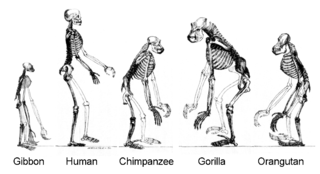
All organisms on Earth are descended from a common ancestor or ancestral gene pool.[157] Current species are a stage in the process of evolution, with their diversity the product of a long series of speciation and extinction events.[219] The common descent of organisms was first deduced from four simple facts about organisms: First, they have geographic distributions that cannot be explained by local adaptation. Second, the diversity of life is not a set of completely unique organisms, but organisms that share morphological similarities. Third, vestigial traits with no clear purpose resemble functional ancestral traits, and finally, that organisms can be classified using these similarities into a hierarchy of nested groups - similar to a family tree.[7] However, modern research has suggested that, due to horizontal gene transfer, this "tree of life" may be more complicated than a simple branching tree since some genes have spread independently between distantly related species.[220][221]
Past species have also left records of their evolutionary history. Fossils, along with the comparative anatomy of present-day organisms, constitute the morphological, or anatomical, record.[222] By comparing the anatomies of both modern and extinct species, paleontologists can infer the lineages of those species. However, this approach is most successful for organisms that had hard body parts, such as shells, bones or teeth. Further, as prokaryotes such as bacteria and archaea share a limited set of common morphologies, their fossils do not provide information on their ancestry.
More recently, evidence for common descent has come from the study of biochemical similarities between organisms. For example, all living cells use the same basic set of nucleotides and amino acids.[223] The development of molecular genetics has revealed the record of evolution left in organisms' genomes: dating when species diverged through the molecular clock produced by mutations.[224] For example, these DNA sequence comparisons have revealed the close genetic similarity between humans and chimpanzees and shed light on when the common ancestor of these species existed.[225]
Evolution of life
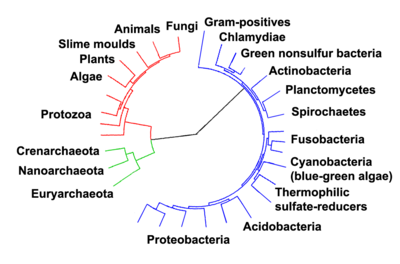
Despite the uncertainty on how life began, it is generally accepted that prokaryotes inhabited the Earth from approximately 3–4 billion years ago.[227][228] No obvious changes in morphology or cellular organization occurred in these organisms over the next few billion years.[229]
The eukaryotes were the next major change in cell structure. These came from ancient bacteria being engulfed by the ancestors of eukaryotic cells, in a cooperative association called endosymbiosis.[97][230] The engulfed bacteria and the host cell then underwent co-evolution, with the bacteria evolving into either mitochondria or hydrogenosomes.[231] An independent second engulfment of cyanobacterial-like organisms led to the formation of chloroplasts in algae and plants.[232] It is unknown when the first eukaryotic cells appeared though they first emerged between 1.6 - 2.7 billion years ago.
The history of life was that of the unicellular eukaryotes, prokaryotes, and archaea until about 610 million years ago when multicellular organisms began to appear in the oceans in the Ediacaran period.[227][233] The evolution of multicellularity occurred in multiple independent events, in organisms as diverse as sponges, brown algae, cyanobacteria, slime moulds and myxobacteria.[234]
Soon after the emergence of these first multicellular organisms, a remarkable amount of biological diversity appeared over approximately 10 million years, in an event called the Cambrian explosion. Here, the majority of types of modern animals appeared in the fossil record, as well as unique lineages that subsequently became extinct.[235] Various triggers for the Cambrian explosion have been proposed, including the accumulation of oxygen in the atmosphere from photosynthesis.[236] About 500 million years ago, plants and fungi colonized the land, and were soon followed by arthropods and other animals.[237] Amphibians first appeared around 300 million years ago, followed by early amniotes, then mammals around 200 million years ago and birds around 100 million years ago (both from "reptile"-like lineages). However, despite the evolution of these large animals, smaller organisms similar to the types that evolved early in this process continue to be highly successful and dominate the Earth, with the majority of both biomass and species being prokaryotes.[136]
Social and cultural responses

In the 19th century, particularly after the publication of On the Origin of Species in 1859, the idea that life had evolved was an active source of academic debate centered on the philosophical, social and religious implications of evolution. Nowadays, the fact that organisms evolve is uncontested in the scientific literature and the modern evolutionary synthesis is widely accepted by scientists.[12] However, evolution remains a contentious concept for some theists.[239]
While various religions and denominations have reconciled their beliefs with evolution through concepts such as theistic evolution, there are creationists who believe that evolution is contradicted by the creation myths found in their respective religions and who raise various objections to evolution.[126][240][241] As had been demonstrated by responses to the publication of Vestiges of the Natural History of Creation in 1844, the most controversial aspect of evolutionary biology is the implication of human evolution that human mental and moral faculties, which had been thought purely spiritual, are not distinctly separated from those of other animals.[6] In some countries—notably the United States—these tensions between science and religion have fueled the current creation-evolution controversy, a religious conflict focusing on politics and public education.[242] While other scientific fields such as cosmology[243] and earth science[244] also conflict with literal interpretations of many religious texts, evolutionary biology experiences significantly more opposition from religious literalists.
Another example associated with evolutionary theory that is now widely regarded as unwarranted is misnamed "Social Darwinism," a term given to the 19th century Whig Malthusian theory developed by Herbert Spencer into ideas about "survival of the fittest" in commerce and human societies as a whole, and by others into claims that social inequality, sexism, racism, and imperialism were justified.[245] However, these ideas contradict Darwin's own views, and contemporary scientists and philosophers consider these ideas to be neither mandated by evolutionary theory nor supported by data.[246][247][248]
The teaching of evolution in American secondary school biology classes was uncommon in most of the first half of the 20th century. The Scopes Trial decision of 1925 caused the subject to become very rare in American secondary biology textbooks for a generation, but it was gradually re-introduced about a generation later and legally protected with the 1968 Epperson v. Arkansas decision. Since then, the competing religious belief of creationism was legally disallowed in secondary school curricula in various decisions in the 1970s and 1980s, but it returned in the form of intelligent design, to be excluded once again in the 2005 Kitzmiller v. Dover Area School District case.[249]
Applications
Evolutionary biology, and in particular the understanding of how organisms evolve through natural selection, is an area of science with many practical applications.[250] A major technological application of evolution is artificial selection, which is the intentional selection of certain traits in a population of organisms. Humans have used artificial selection for thousands of years in the domestication of plants and animals.[251] More recently, such selection has become a vital part of genetic engineering, with selectable markers such as antibiotic resistance genes being used to manipulate DNA in molecular biology. It is also possible to use repeated rounds of mutation and selection to evolve proteins with particular properties, such as modified enzymes or new antibodies, in a process called directed evolution.[252]
Understanding the changes that have occurred during organism's evolution can reveal the genes needed to construct parts of the body, genes which may be involved in human genetic disorders.[253] For example, the Mexican tetra is an albino cavefish that lost its eyesight during evolution. Breeding together different populations of this blind fish produced some offspring with functional eyes, since different mutations had occurred in the isolated populations that had evolved in different caves.[254] This helped identify genes required for vision and pigmentation, such as crystallins and the melanocortin 1 receptor.[255] Similarly, comparing the genome of the Antarctic icefish, which lacks red blood cells, to close relatives such as the zebrafish revealed genes needed to make these blood cells.[256]
As evolution can produce highly optimized processes and networks, it has many applications in computer science. Here, simulations of evolution using evolutionary algorithms and artificial life started with the work of Nils Aall Barricelli in the 1960s, and was extended by Alex Fraser, who published a series of papers on simulation of artificial selection.[257] Artificial evolution became a widely recognized optimization method as a result of the work of Ingo Rechenberg in the 1960s and early 1970s, who used evolution strategies to solve complex engineering problems.[258] Genetic algorithms in particular became popular through the writing of John Holland.[259] As academic interest grew, dramatic increases in the power of computers allowed practical applications, including the automatic evolution of computer programs.[260] Evolutionary algorithms are now used to solve multi-dimensional problems more efficiently than software produced by human designers, and also to optimize the design of systems.[

No comments:
Post a Comment